Inhibitory Replay Perturbations Change Excitatory Firing
Recorded inhibitory spike streams produced contrasting excitatory responses under independent-spike and fixed-window replay perturbations, but the experiment does not isolate synchrony.
Abstract
We asked how perturbing inhibitory spike timing changes trained PING classifiers. We reused three frozen MNIST classifiers and their retained inhibitory-spike recordings. We replayed each stream after either shifting every spike independently or shifting all spikes originating in the same fixed clock window together. Independent-spike jitter nearly silenced excitatory neurons, whereas fixed-window shifts increased their firing. Accuracy declined under both perturbations despite preservation of each inhibitory neuron’s spike count. Replay interrupted responsive feedback, so these measurements do not isolate synchrony or a gamma-specific mechanism.
Results
Replay perturbations diverge
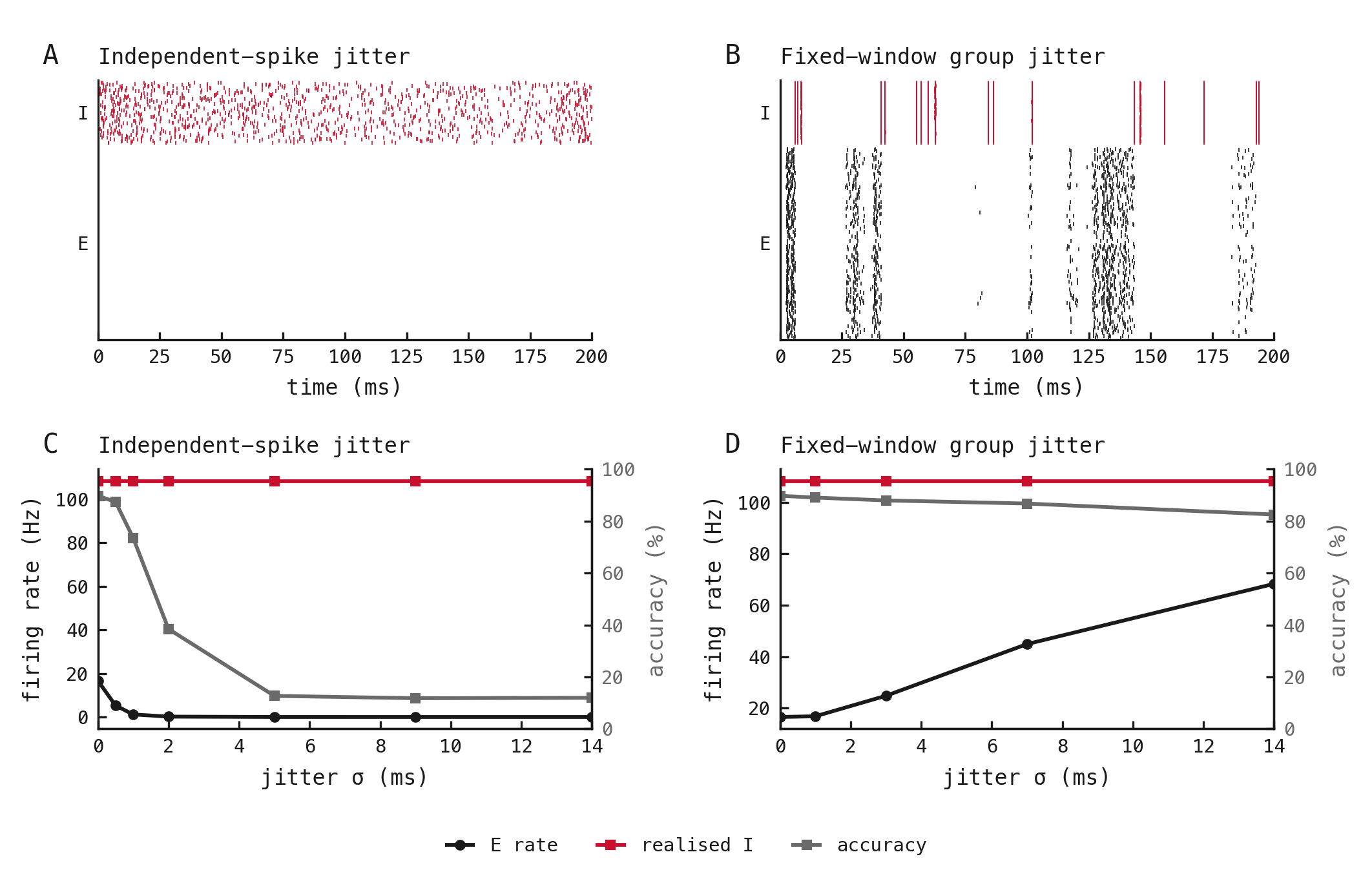
Figure 1: (A) Independent-spike and (B) fixed-window group jitter for the illustrative first test presentation from the training replicate initialized with seed 42 at ms; 200 of 1,024 E neurons and 64 of 256 I neurons are displayed over the 200 ms presentation. (C) Independent-spike and (D) fixed-window sweep summaries show per-neuron E rate, realised I-spike rate and test-accuracy means across three training replicates. Retained SEM across training replicates is not displayed.
Methods
-
Models. We reused three independently trained PING networks, initialized with training seeds 42–44.
-
Trials. We tested each network-condition combination on the same 1,000 MNIST test images. The main figure represents 36,000 condition-level trials, or 33,000 distinct simulations because both arms shared the zero-jitter control.
-
Simulation. We presented each image for 200 ms using a 0.1 ms timestep. We encoded pixel intensities as spike trains with a maximum input rate of 25 Hz, fixed across all training replicates and perturbation conditions. Full-intensity pixels therefore had a 25 Hz encoding rate; lower intensities scaled this rate proportionally.
-
Independent jitter. We gave every inhibitory spike an independent Gaussian time shift, using and ms.
-
Group jitter. We divided the timeline into fixed 22.8 ms windows and gave every inhibitory spike within a window the same shift, using and ms. The window spanned 228 simulation steps, obtained by rounding the period of the fixed 43.95 Hz reference to the 0.1 ms grid; windows were not detected gamma cycles.
-
Boundaries. We reflected independent spikes that left the 200 ms interval back into it individually. For group jitter, we reflected the shared displacement once so that the group remained intact.
-
Collisions. We moved same-neuron spikes landing on the same timestep to the nearest unused in-range timestep. No spikes were removed.
-
Measurements. We recorded accuracy and mean excitatory and inhibitory firing rates. Curves show the mean across the three training seeds.
-
Range restriction. We retained larger jitter values as boundary-sensitivity results but excluded them from the main figure because reflection became a substantial part of the intervention.
Dataset
Figures use the recorded presentation selections and their same-experiment inputs. The table includes completed run history; the presentation used by this report is emphasized. Dates are run creation times in UTC; durations cover each stage separately, and sizes cover its exported files. For imported runs, durations and execution locations refer to the recorded producing execution.
Upstream: exp022 — Training Runs
Downstream: exp110 — Manuscript
| Run | Date | Duration | Size | Ran on |
|---|---|---|---|---|
| exp042-r019-present | 1s | 192.1 KB | Local | |
| exp042-r008-analyse | 4s | 67.5 KB | HPC | |
| exp042-r007-compute | 48s | 216.6 KB | HPC |